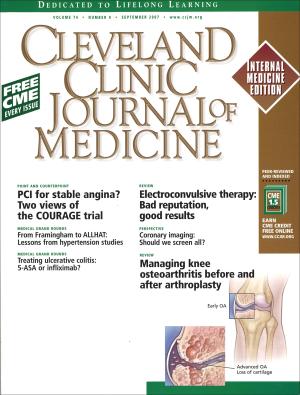
Index by author
September 01, 2007; Volume 74, Issue 9-
ECT: Bad reputation, but often effective
Brian F. Mandell, MD, PhD- Cleveland Clinic Journal of Medicine September 2007, 74 (9) 614;
It may come as a surprise that psychiarists still use electroconvulsive therapy. Books and movies have not portrayed it in a flattering light.
-

Managing knee osteoarthritis before and after arthroplasty
James Rosneck, MD, Carlos A. Higuera, MD, Nabil Tadross, MD, Viktor Krebs, MD and Wael K. Barsoum, MD- Cleveland Clinic Journal of Medicine September 2007, 74 (9) 663-671;
Primary care physicians play a key role in the diagnosis and nonoperative management of knee osteoarthritis, including monitoring for problems in patients who have undergone knee replacement surgery.
-
Hypertension from Framingham to ALLHAT: Translating clinical trials into practice
Daniel Levy, MD- Cleveland Clinic Journal of Medicine September 2007, 74 (9) 672-678;
Most people with hypertension are still not being adequately treated. Newer drugs have not surpassed diuretics in efficacy and safety. Rather than trying to develop newer, more expensive agents, our priority should be to treat more patients and to treat them more aggressively.
-
Interpreting the Courage Trial
Dean J. Kereiakes, MD- Cleveland Clinic Journal of Medicine September 2007, 74 (9) 637-642;
COURAGE had several problems, and tells us nothing new.
-
Interpreting the Courage Trial
Deepak L. Bhatt, MD- Cleveland Clinic Journal of Medicine September 2007, 74 (9) 618-620;
We are fortunate to have a point-counterpoint between Dr. William Boden, the principal investigator of the Clinical Outcomes Utilizing Percutaneous Coronary Revascularization and Aggressive Drug Evaluation (COURAGE) trial, and Dr. Dean Kereiakes, a leading interventional cardiologist.
-
Electroconvulsive therapy: What the internist needs to know
Mayur Pandya, DO, Leopoldo Pozuelo, MD and Donald Malone, MD- Cleveland Clinic Journal of Medicine September 2007, 74 (9) 679-685;
Despite its bad reputation, electroconvulsive therapy is safe and effective for treating a number of psychiatric disorders. For some patients, it is the only therapy that works.
-
Managing knee osteoarthritis before and after arthroplasty
James Rosneck, MD, Carlos A. Higuera, MD, Nabil Tadross, MD, Viktor Krebs, MD and Wael K. Barsoum, MD- Cleveland Clinic Journal of Medicine September 2007, 74 (9) 663-671;
Primary care physicians play a key role in the diagnosis and nonoperative management of knee osteoarthritis, including monitoring for problems in patients who have undergone knee replacement surgery.
-
Ulcerative colitis: Responding to the challenges
Jean-Paul Achkar, MD- Cleveland Clinic Journal of Medicine September 2007, 74 (9) 657-660;
Aminosalicylates are the first-line therapy for patients with mild to moderate active ulcerative colitis. Infliximab is now approved for moderately to severely active ulcerative colitis in patients who have had an inadequate response to conventional therapy.
-
Electroconvulsive therapy: What the internist needs to know
Mayur Pandya, DO, Leopoldo Pozuelo, MD and Donald Malone, MD- Cleveland Clinic Journal of Medicine September 2007, 74 (9) 679-685;
Despite its bad reputation, electroconvulsive therapy is safe and effective for treating a number of psychiatric disorders. For some patients, it is the only therapy that works.
-
Electroconvulsive therapy: What the internist needs to know
Mayur Pandya, DO, Leopoldo Pozuelo, MD and Donald Malone, MD- Cleveland Clinic Journal of Medicine September 2007, 74 (9) 679-685;
Despite its bad reputation, electroconvulsive therapy is safe and effective for treating a number of psychiatric disorders. For some patients, it is the only therapy that works.