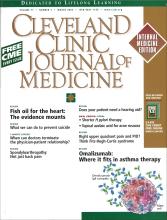

Table of Contents
From the Editor
- Fish oil is no snake oil
That cod-liver oil I took as a child, though foul tasting, may have been good for my heart.
1-Minute Consult
- When and how is it appropriate to terminate the physician-patient relationship?
This should be a last resort, done only in extreme cases, and only after trying to work things out, giving fair warning, and making sure you are not abandoning the patient.
Review
- Spondyloarthropathies: Using presentation to make the diagnosis
Spondylitis is easy to miss and is often falsely assumed to be “just back pain.” Inhibitors of tumor necrosis factor show promise as treatments, but data are still limited.
- Fish oil supplementation: Evidence for health benefits
We have solid and compelling evidence that two long-chain omega-3 fatty acids help prevent coronary heart disease.
- Hearing loss is often undiscovered, but screening is easy
Does your patient need a hearing aid? Primary care physicians—the gatekeepers of audiologic care—can play a more active role in improving the hearing of their adult patients.
- Fitz-Hugh-Curtis syndrome: A diagnosis to consider in women with right upper quadrant pain
Does your patient need a hearing aid? Primary care physicians—the gatekeepers of audiologic care—can play a more active role in improving the hearing of their adult patients.
- What physicians can do to prevent suicide
No one can predict whether any given patient will or will not attempt suicide, but we should notice when a patient might be at risk—and not be afraid to ask about it.
 Omalizumab: Where does it fit into current asthma management?
This drug offers substantial promise, but owing to its cost and other limitations, it is not a first-line therapy.