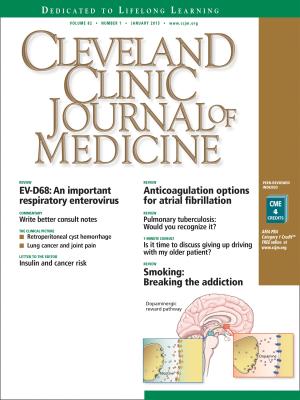
Table of Contents
January 01, 2015; Volume 82, Issue 1-
From the Editor
-
A new year and a new face for www.ccjm.org
Brian F. Mandell, MD, PhD- Cleveland Clinic Journal of Medicine January 2015, 82 (1) 9;
- DOI: https://doi.org/10.3949/ccjm.82b.01015
CCJM.org has a new look and new interactive features, but it remains open to all and free of charge. Log on and register.
-
-
Commentary
-
Short and sweet: Writing better consult notes in the era of the electronic medical record
K.K. Venkat, MD- Cleveland Clinic Journal of Medicine January 2015, 82 (1) 13-17;
- DOI: https://doi.org/10.3949/ccjm.82a.14008
Avoid repeating everything already in the record, but include your reasoning and teaching points.
-
-
The Clinical Picture
-
Joint pain in a man with lung cancer
Emily Jernigan, BS, Nadia Siddiqi, DO and Prashanth Peddi, MD- Cleveland Clinic Journal of Medicine January 2015, 82 (1) 18-19;
- DOI: https://doi.org/10.3949/ccjm.82a.13137
Hypertrophic pulmonary osteoarthropathy is characterized by proliferation of the skin and periosteal formation of new bone.
-
Retroperitoneal cyst hemorrhage in polycystic kidney disease
Cathy I. Cheng, MD, Nicolas B. Karvelas, MD and Paul Aronowitz, MD- Cleveland Clinic Journal of Medicine January 2015, 82 (1) 20-21;
- DOI: https://doi.org/10.3949/ccjm.82a.14007
Polycystic kidney disease is relatively common, and fewer than half of cases are diagnosed. The cysts often bleed.
-
-
1-Minute Consult
-
When should I discuss driving with my older patients?
Kenneth Koncilja, MD, Barbara J. Messinger-Rapport, MD, PhD and Quratulain Syed, MD- Cleveland Clinic Journal of Medicine January 2015, 82 (1) 22-25;
- DOI: https://doi.org/10.3949/ccjm.82a.14036
Discuss driving safety with any patient who is age 80 or older, `or who has a high-risk medical condition.
-
-
Review
-
Enterovirus D68: A clinically important respiratory enterovirus
Charles B. Foster, MD, Neil Friedman, MD, John Carl, MD and Giovanni Piedimonte, MD- Cleveland Clinic Journal of Medicine January 2015, 82 (1) 26-31;
- DOI: https://doi.org/10.3949/ccjm.82a.14166
Seasonal peaks of viral respiratory illnesses are common during late summer and early fall and have often been attributed to human rhinovirus. In the fall of 2014, the number of children hospitalized with severe lower respiratory symptoms and asthma suddenly increased, and the children tested positive by sequencing for enterovirus D68 (EV-D68). As the outbreak unfolded, a possible association was also observed between EV-D68 infection, polio-like acute flaccid paralysis, and cranial neuropathy in children.
-
Rule out pulmonary tuberculosis: Clinical and radiographic clues for the internist
Catherine Anne Curley, MD- Cleveland Clinic Journal of Medicine January 2015, 82 (1) 32-38;
- DOI: https://doi.org/10.3949/ccjm.82a.14014
As tuberculosis rates decline in the United States, clinicians are less likely to consider it early in a patient’s illness. Certain clinical and radiographic features increase the likelihood of tuberculosis. This review covers the clinical and radiographic features of tuberculosis, the initial evaluation of the patient, the use of airborne infection isolation, and the utility of new molecular techniques in diagnosing tuberculosis.
-

Quitting smoking: Still a challenge, but newer tools show promise
Gregory B. Collins, MD, DFAPA, Jason M. Jerry, MD, FAPA and Robert Bales, MD, MPH, FAAFP- Cleveland Clinic Journal of Medicine January 2015, 82 (1) 39-48;
- DOI: https://doi.org/10.3949/ccjm.81a.14016
Smoking continues to be a major public health problem with devastating consequences in terms of morbidity and mortality. Physicians are strongly encouraged to engage patients in a serious, concerted, and consistent effort to overcome nicotine addiction. Brief counseling in combination with medications has been shown to be effective. This article provides physicians guidelines for helping patients to quit this addictive disorder.
-
Selecting antithrombotic therapy for patients with atrial fibrillation
Christine Tanaka-Esposito, MD and Mina K. Chung, MD- Cleveland Clinic Journal of Medicine January 2015, 82 (1) 49-63;
- DOI: https://doi.org/10.3949/ccjm.82a.140002
When considering anticoagulant therapy for patients with atrial fibrillation, one must balance the reduction in risk of thromboembolism that this therapy offers against the risk of bleeding that it poses. The American Heart Association, American College of Cardiology, and Heart Rhythm Society updated their atrial fibrillation guidelines in 2014. This review outlines a rationale for clinical decision-making based on the new guidelines and summarizes the currently approved drugs.
-
-
Departments
-
Insulin therapy and cancer risk (October 2014)
Athanasios Fountas, MD, MHA, MSc, Georgia Rosiou, MD and Agathocles A. Tsatsoulis, MD, PhD, FRCP- Cleveland Clinic Journal of Medicine January 2015, 82 (1) 11;
- DOI: https://doi.org/10.3949/ccjm.82c.01001
A reader comments on whether insulin therapy increases the risk of cancer (October 2014).
-
In Reply: Insulin therapy and cancer risk (October 2014)
Grace E. Ching Sun, DO, Sangeeta R. Kashyap, MD and Christian Nasr, MD- Cleveland Clinic Journal of Medicine January 2015, 82 (1) 11-12;
- DOI: https://doi.org/10.3949/ccjm.82c.01002
A reader comments on whether insulin therapy increases the risk of cancer (October 2014).
-