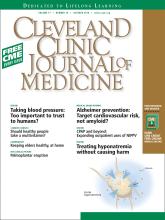

Table of Contents

October 01, 2010; Volume 77, Issue 10
  • From the Editor

      • Finding the right target for treating Alzheimer disease

        Brian F. Mandell, MD, PhD
        • Cleveland Clinic Journal of Medicine October 2010, 77 (10) 650;
        • DOI: https://doi.org/10.3949/ccjm.77b.10010
        • It is not always easy to pick a therapeutic target. Sometimes, potential targets are actually embers of the pathologic process rather than flames driving the disease.

  • 1-Minute Consult

      • Should healthy people take a multivitamin?

        Benjamin Caballero, MD, PhD
        • Cleveland Clinic Journal of Medicine October 2010, 77 (10) 656-657;
        • DOI: https://doi.org/10.3949/ccjm.77a.10070
        • No. There is no scientific basis for recommending vitamin-mineral supplements to the healthy population.

  • Commentary

      • Bringing home the ‘medical home’ for older adults

        Steven H. Landers, MD, MPH, Paula Suter, RN, MA, CCP and Beth Hennessey, MSN, RN
        • Cleveland Clinic Journal of Medicine October 2010, 77 (10) 661-675;
        • DOI: https://doi.org/10.3949/ccjm.77a.10006
        • We may be able to improve the care of our vulnerable older patients—and control costs—by taking their primary care to their own homes.

  • Editorial

      • Is there a doctor in your house? Home health care of the future

        John Hickner, MD, MSc
        • Cleveland Clinic Journal of Medicine October 2010, 77 (10) 681-682;
        • DOI: https://doi.org/10.3949/ccjm.77a.10100
        • A modernized, efficient, effective home health care system would be a welcome improvement on the patchwork system we have had for the past 30 years.

  • Review

      • Taking blood pressure: Too important to trust to humans?

        Donald G. Vidt, MD, Richard S. Lang, MD, MPH, Raul J. Seballos, MD, Anita Misra-Hebert, MD, John Campbell, MD and James F. Bena, MS
        • Cleveland Clinic Journal of Medicine October 2010, 77 (10) 683-688;
        • DOI: https://doi.org/10.3949/ccjm.77a.09155
        • The reality of blood pressure measurement is that human beings do not do it very well. The time has come to delegate this job to machines that can do it better.

  • Medical Grand Rounds

      • Alzheimer disease prevention: Focus on cardiovascular risk, not amyloid?

        David S. Geldmacher, MD
        • Cleveland Clinic Journal of Medicine October 2010, 77 (10) 689-704;
        • DOI: https://doi.org/10.3949/ccjm.77gr.2010
        • Efforts to modify the course of Alzheimer disease have, until now, been based on altering the production or clearance of beta-amyloid. Results have been disappointing.

  • Review

      • Noninvasive positive pressure ventilation for stable outpatients: CPAP and beyond

        Theerakorn Theerakittikul, MD, Basma Ricaurte, MD and Loutfi S. Aboussouan, MD
        • Cleveland Clinic Journal of Medicine October 2010, 77 (10) 705-714;
        • DOI: https://doi.org/10.3949/ccjm.77a.10060
        • We discuss the different types of noninvasive positive pressure ventilation, the specific conditions in which they can be used, and the evidence supporting their efficacy in outpatients.

      • TOC Icon

        Management of hyponatremia: Providing treatment and avoiding harm

        Chirag Vaidya, MD, Warren Ho, MD and Benjamin J. Freda, DO
        • Cleveland Clinic Journal of Medicine October 2010, 77 (10) 715-726;
        • DOI: https://doi.org/10.3949/ccjm.77a.08051
        • Undercorrection of acute symptomatic hyponatremia can lead to serious neurologic injury, but so can overly rapid correction of chronic hyponatremia.

  • The Clinical Picture

      • Palmoplantar eruption

        Salvador Arias-Santiago, MD, Husein Husein-ElAhmed, MD, José Aneiros-Fernández, MD, María Sierra Girón-Prieto, MD and Ramón Naranjo-Sintes, PhD
        • Cleveland Clinic Journal of Medicine October 2010, 77 (10) 729-731;
        • DOI: https://doi.org/10.3949/ccjm.77a.09175
        • A 38-year-old woman with a history of episodes of arthritis presents with pustules on the palms and on the soles of her feet. What is the most likely diagnosis?